

Access Audio Tour
The Hospital’s external landscape was designed by Tract to create a restorative, accessible and nature-rich environment. Rob Copeland explains how the brief shaped a bold approach to planting, outdoor spaces and movement networks, all anchored by a central Village Green.
From here, he identifies key features, highlighting the relationship between garden areas and the buildings and how these green spaces are intended to support comfort, recovery and everyday use.
ListenThe Village Green
At 150m long and 100m wide, this massive open space forms a central arrival experience and entrance to the campus. Linked to the landscape of nearby Footscray Park and the Maribyrnong River, the Village Green at the heart of Footscray Hospital contributes a new publicly accessible open space for the wider community to enjoy.
A welcoming garden with spaces to sit and gather, the Village Green also holds a ceremonial space and fire pit, developed in collaboration with Wurundjeri Elders, a children’s play space and generous native planting, shade trees and lawn area for informal play and relaxation.
Hidden beneath your feet is the basement carpark which extends across the majority of the site. The landscaped Village Green is a testament to engineering and design – the raised podium slab provides sufficient topsoil depth to allow for tree planting, while balancing weight restrictions in the structural design.
Landscape Design
Nature provides a healing environment, supporting improved mental and physical health. The landscape design offers a range of spaces for gathering, respite or therapy and social spaces to interact, welcoming the community and encouraging interaction with nature.
The landscape has been carefully designed to connect internal areas with greenery and light filled natural spaces throughout the whole hospital. Physical and visual access to nature through courtyards, roof terraces, green roofs and winter gardens helps to support the wellness of patients, staff and visitors.
Planting and Place
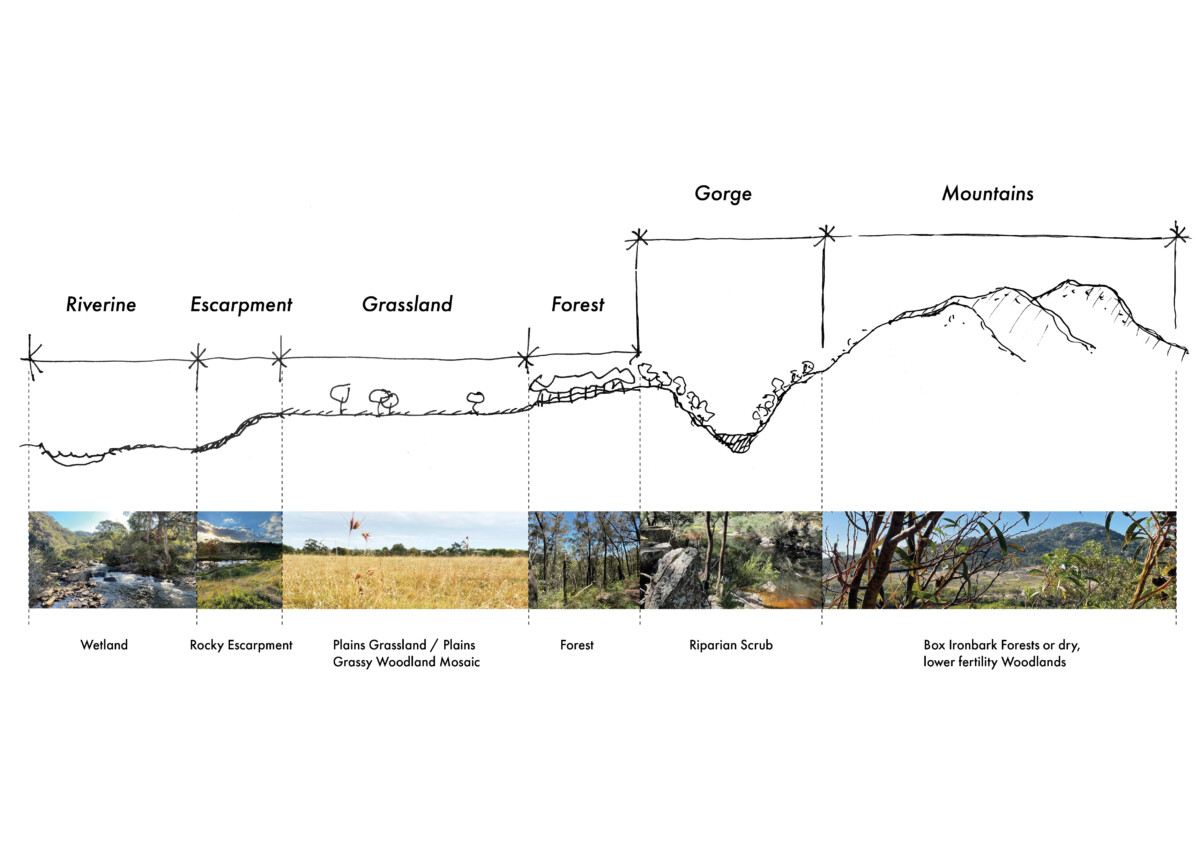
Covering almost 4 hectares, the site includes multiple plant ecosystems and microclimates – with changes in sun exposure, soil depth, and wind conditions. Across 20,000 square metres of external spaces, courtyards, terrace spaces, winter gardens and green roofs, the planting selection and design draws the landscape of western Melbourne and beyond – from the Maribyrnong River through the grassy volcanic plains to the You Yang ranges.
Over 59,000 plants were installed, including 320 semi-advanced trees. More than 95% of the shrubs, groundcovers, ferns and climbers are native and many reflect the horticulture and biodiversity of the Footscray region.
Heritage bricks reclaimed from the demolished houses on site have been used as wall facing, and other bluestone elements included in the play space. During excavation, a number of basalt (bluestone) boulders were recovered, and now live within the First Nations courtyard and the paving of the ceremonial space, offering a moment of connection back to Country.
Sustainability
Native and biodiverse plant selection contributes to the target of 5 Star Green Star rating. Various Water Sensitive Urban Design measures are included in the design, with roof water captured, stored and re-used for irrigation. Stormwater runoff from paved areas drains into planting areas and rain gardens in the streetscape to provide passive irrigation and infiltration of stormwater runoff. The use of natural materials like stone and timber, and roof gardens all contribute to improved sustainability.
The scheme also achieves a Gold WELL certification rating through careful design of the buildings and environment with features that positively impact human health and wellbeing. Inclusion of access to light and sunshine, areas for respite within the landscape and provision for movement and rehabilitation contribute to this goal.
Find out more about the WELL Rating System: Enhance Your Building’s Health.
Safety, Accessibility and Universal Design
Importantly – the ‘People’s Hospital’ is for everyone. The entire project design is founded on consideration of access and mobility of users across the site, with universal design principles guiding the development of all internal and external spaces.
Features include generous graded accessible pathways with minimal steps or ramps, handrails and barriers where required, and furniture designed and positioned to provide for all users – with space for wheelchairs, walking frames and other mobility aids.
About Tract
Tract is a national planning and design practice specialising in town planning, urban design, landscape architecture and associated digital media. As planners and designers our charter is to deliver sustainable and memorable solutions, shaping places for living, leisure and work, and the infrastructure that supports and connects these places. We do this by harnessing the strength and diversity of our collective expertise, across Queensland, Victoria, New South Wales, and South Australia. After 50 years of practice, we continue to evolve so that we shape contemporary thinking, working in partnership with our clients to deliver compelling and inspiring project outcomes.
Find out more